Watch the video
Originally published on LinkedIn · June 15, 2026 · Jeff Mays
The Shift Is Happening Right Now
What I experienced with that dentist search isn't a fluke. It's the new reality rolling out across Google — and it's happening faster than most people realize.
At Google I/O 2026 back in May, Google made it clear: AI-powered search is the future, and they're accelerating the rollout. Every week, they're expanding AI Overviews and AI-generated recommendations to more business categories and more search queries.
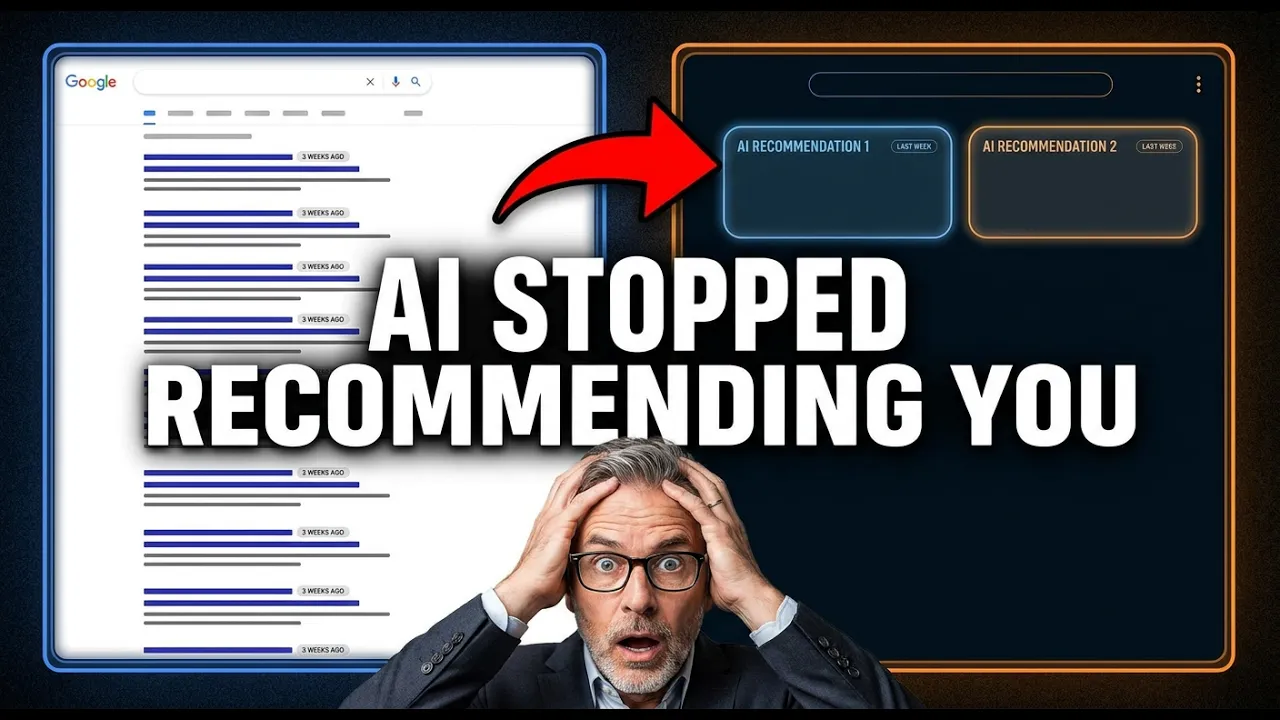
The traditional list of options is being replaced by a curated short list of recommendations. Sometimes it's three businesses. Sometimes it's two. Sometimes it's one.
And if your client isn't on that list, they might as well be invisible.
Why "Can AI Find You?" Is the Wrong Question
Here's what I kept seeing in the audits I was running: businesses would show up in AI search results, but they wouldn't get recommended.
A restaurant owner could see his business mentioned when someone asked ChatGPT about Italian restaurants in his area — but he wasn't on the recommendation list. He was just... there. Visible but not chosen.
And here's the tricky part: business owners often think they're doing fine because they can see themselves when they search locally. Their computer, their phone, their IP address — it all shows them their own business. But when I run the same search from a different location, or when AI makes a recommendation to someone across town? They're not there.
That local bias creates a dangerous blind spot. Business owners think AI is recommending them because they see themselves. But AI isn't actually recommending them to anyone else.
Why Recommendation Is Everything
Think about how people actually use AI now.
They don't ask "show me all the plumbers in my area." They ask "who should I hire to fix my water heater?" or "what's the best dentist near me for a crown replacement?"
They're not looking for options to research. They're looking for a decision to be made for them.
And AI is happy to oblige. It evaluates the options, weighs the signals, and gives a short answer: "I recommend..."
If your client isn't in that answer, the conversation is over. The potential customer never visits their website. Never sees their reviews. Never calls.
The search happened. The decision was made. Your client lost — and they don't even know it.
The Pattern I Keep Seeing
I've been running audits for agencies over the past few weeks, and the pattern is consistent:
A business might appear when AI searches for local options, but they don't make the recommendation list. Their competitor does.
The business owner argues they can see themselves in AI results — because they're searching from their own location and device.
But when I run the audit from our system, or when a potential customer asks AI for a recommendation from across town, that business is nowhere to be found.
Visibility without recommendation is worthless. It's like being listed in the phone book but never getting called.
We Were Also Serving the Wrong Customer
Here's the other thing I realized: even if I could show a business owner they weren't being recommended by AI, I couldn't actually help them fix it.
The fixes AI visibility requires aren't surface-level. They're not "add some keywords to your homepage" fixes. They require:
New schema markup and structured data
Updated or entirely new pages targeting specific services
Citation cleanup across dozens of directories
Review generation strategies
Content optimization that AI systems can actually parse
A typical business owner doesn't have the skills or the time to do any of that. They can't go into their website's backend and add schema. They don't know what a citation is, let alone how to fix inconsistent ones across 40+ directories.
But you know who can do all of that?
The agencies and web designers who built those websites in the first place.
The Web Design Industry Is Dying — But It Doesn't Have To
Over the past few weeks, I've had conversations with web designers and small agency owners I've known for years. The story is always the same:
"The website business is gone. AI can build a site for $500 that used to cost $3,000. Clients are canceling subscriptions. I don't know what's next."
One guy I know ran a small marketing agency with his wife for nearly a decade. They had a solid subscription model — monthly website management, updates, hosting. It was working.
I called him a few weeks ago to tell him about RediForAI. I thought he'd be perfect for it — smart, forward-thinking, great with clients.
We met for breakfast, and he told me he'd already gotten out of the business. Took a customer service job with a contractor. His wife is still managing a few of their old website clients part-time with some VAs, but they've both moved on.
He didn't seem happy about it. But he'd given up.
The Opportunity Hiding in Plain Sight
Here's what I realized: web designers and agencies aren't being replaced by AI. They're being displaced because they're still selling yesterday's service.
Building websites is becoming commoditized. But helping businesses get recommended by AI? That's brand new. And it requires exactly the skills agencies already have.
The agencies that survive — and thrive — will be the ones who pivot from "we build websites" to "we make sure AI recommends your business."
And here's the best part: this isn't a one-time project. AI systems update constantly. Google rolls out changes every few weeks. What works today might not work next month.
That means ongoing monitoring. Monthly optimization. Recurring revenue.
The same business model agencies have been losing in website subscriptions can be rebuilt around AI visibility management.
What This Means Right Now
If you're an agency or web designer reading this, here's my challenge: pick five of your current or past clients and run AI visibility audits on them.
Ask ChatGPT, Google AI, and Perplexity: "Who's the best [their business type] in [their city]?"
See if your clients show up. See who does show up instead.
Then ask yourself: do my clients know this is happening? Do they know their competitors are being recommended while they're invisible?
Because if you're not having this conversation with them, someone else will.
The question isn't "Can AI find your business?" anymore.
The question is: "Will AI recommend your business when someone asks?"
And if the answer is no, that's a problem you can solve.